


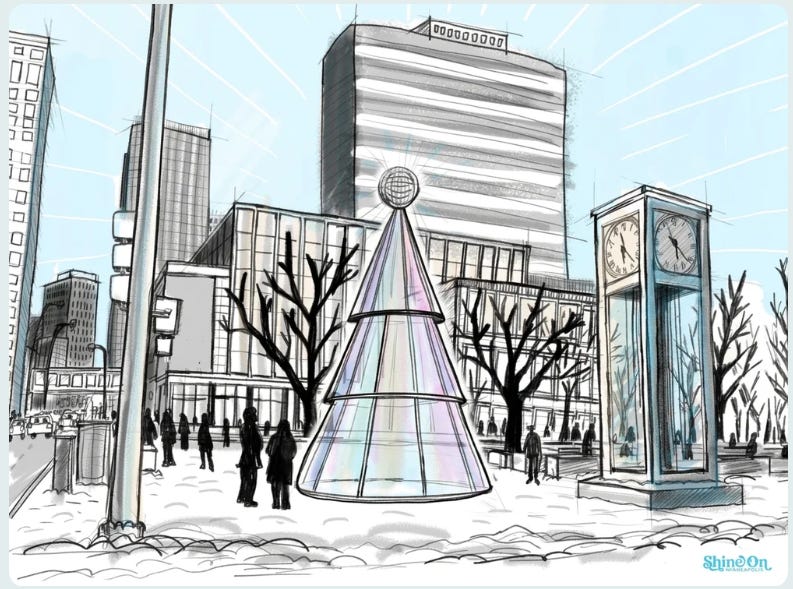
Downtown Minneapolis kicked off its holiday season on Friday, Nov. 27. The Shine On Minneapolis program highlights the food, shopping, music, art, lights and dancing downtown. The events include a First Snowball Toss, the World Marshmallow Roasting Championship and a Winter Kickoff Block Party with a DJ. They are a partnership between the city and the Minneapolis Foundation. Peavey Plaza has an artist-designed holiday tree, and Christmas trees are on sale while supplies last.
Council Member Michael Rainville joined Mayor Jacob Frey at the kickoff events. Social media “influencers” came too. When one of them tried to interrupt the speakers to film, Rainville stepped in and shut it down. The video has been replayed thousands of times on social media, and most people have applauded him. Many people are tired of online hectoring and bullying, and they were glad to see Rainville take a stand. His frustration with these tactics is clear. Many people don’t speak up, but they support him when he does.
Have these breathless, on-the-scene “news” posts finally reached a saturation point? Hyper-sensational posts and manufactured outrage are not helping the city make progress or improving public conversation. They are good at generating clicks and keeping people on the social media platforms we love to hate. The biggest beneficiaries are advertisers and marketers who see users as wallets to tap.
The City After the Parade
Once the glitter is swept up and the DJ equipment is packed away, we hope our leaders can get down to the serious work of making downtown a thriving city center again. We recommend looking south to Rochester. Twin Cities Business highlighted its success in a Nov. 25 article, “U of M in Rochester Growing Rapidly Thanks to Medical Focus.” To summarize, Discovery Square in Rochester is growing rapidly because of a partnership between the University of Minnesota Rochester (UMR) and the city to educate and train people for health care jobs that are in demand. It took decades of planning, but this partnership is working. It was designed to attract and keep entrepreneurs and health care pioneers in Rochester.
“UMR chancellor Lori Carrell cites Minnesota Department of Health data showing that up to 80% of Minnesota counties are experiencing shortages of healthcare professionals across several areas. As a career path, healthcare has shown growing appeal among young Americans.”
Minneapolis prides itself on being a beacon of social justice and progressive politics. But we are also stalled, with exorbitant property taxes and no clear direction for revitalization. We need to think harder about how to translate our values into dignified work that sustains families and creates pathways to upward mobility. Without that, we are unlikely to see much change in the wealth and education gaps that are at least partly responsible for the unequal outcomes residents experience.
New-student enrollment at the University of Minnesota Twin Cities fell 6.2%, while UMR’s enrollment rose 13.7%. City and education leaders in Rochester have been intentional about creating academic programs that lead to high-paying jobs. Minneapolis can follow that recipe. In January, the innovation district in downtown Rochester begins a $10 million, 12,600-square-foot lab and classroom expansion. This growth won’t be short-lived, either. As more students and startups see the value of this partnership and experience the facilities, more will come. Rochester has created an ecosystem that supports innovation and growth. It is time for Minneapolis to create its own innovation district.
Minneapolis could be an educational leader in plenty of areas, and we don’t have to copy Rochester exactly. Downtown already has space for new classrooms, and we have built the transit to bring people to labs, classrooms and lecture halls. What we need is the vision and the dedicated resources to bring these pieces together.
That vision will most likely require help from the Legislature. But Minneapolis first needs a plan it can take to the Capitol and a clear, persuasive case for why investing in Minneapolis will pay dividends for the whole state.
Behavioral health care is a good place to start. The DFL trifecta must do more than continue its flawed practice of outsourcing mental health care and substance abuse treatment to unregulated providers. Now is the time to create training programs so we have the best providers in the country. The city, working with the state and the university, can create programs that make sure providers are certified and have skilled managers who know how to run a business in compliance with regulations. Minnesota has a tremendous need for more professional behavioral health care, but we lack the programs and facilities to meet that demand. It is one example of how Minneapolis could build an industry consistent with its values.

The First Step to Thinking Bigger
Opposition to data centers was one of many factors that motivated voters in November’s election. According to a story from the BBC:
“The poll for AP and a consortium of news organisations found 56% of surveyed voters said data centres were a “crucial or major” factor in their vote, while 76% said they would oppose the construction of a new data centre in their community.”
We understand the opposition. Data centers are a symbol of the AI industry, and its leaders keep talking about end-of-work and end-of-the-world scenarios. It is understandable that people are hesitant to help bring that about. Arguments that data centers are needed downtown for jobs and tax revenue are falling flat with many people. It may not be a fair comparison, but if you ask people what matters more, lowering their property taxes or helping bring about the end of work and the planet, it isn’t surprising that many are willing to pay higher taxes. There are other possibilities, of course, but this either/or question is shaping the debate for many people.
Data center opponents would strengthen their argument by offering an alternative. They need to recognize how important it is to turn downtown Minneapolis into an economic engine for the whole state. Minneapolis may never be a technology hub like San Francisco, Seattle or Washington, D.C., but it can find its own path. Using Rochester as a blueprint for a health care innovation district seems achievable. First, though, we need leaders who recognize this work is part of their jobs.


